Josef Albers (1888–1976) was born in Bottrop, in Germany's Ruhr Valley, on 19 March 1888. After working as a schoolteacher and art teacher, he entered the Weimar Bauhaus in 1920 and in 1925 became one of the first students appointed a Bauhaus master, working in glass, typography, furniture, and design. Following the school's closure in 1933, he and his wife, the artist Anni Albers, emigrated to the United States, where he taught at Black Mountain College in North Carolina (1933–49) and later served as head of the newly formed Department of Design at Yale University (from 1950).
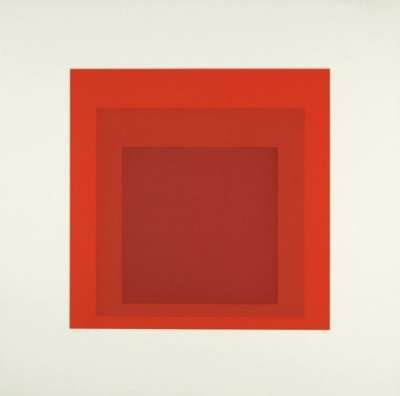
Albers is central to modern color theory. His book Interaction of Color (1963) and the long-running series Homage to the Square, begun in the 1950s, investigate how adjacent colors change one another's appearance. He was also a prolific printmaker, collaborating with workshops including Ives-Sillman in New Haven and the Tamarind Lithography Workshop. In 1971 he became the first living artist to receive a solo retrospective at the Metropolitan Museum of Art, New York. The Josef and Anni Albers Foundation in Bethany, Connecticut, stewards his legacy.